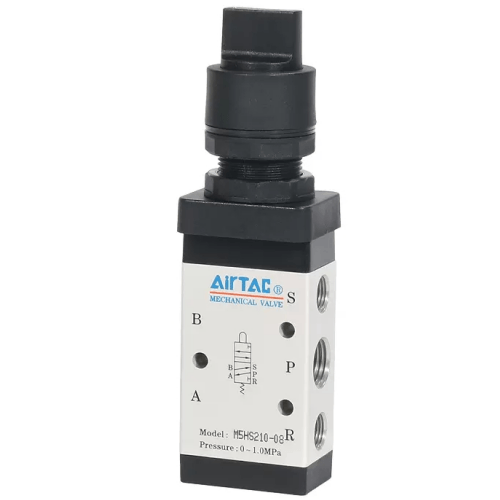
Airtac M5HS Selector Mechanical Valve M5HS11006R
Mechanically actuated · no coil, no pilot airThe AirTAC Airtac M5HS Selector Mechanical Valve M5HS11006R is a genuine 5/2-way selector switch type control valve. A turn-and-stay selector. Manual restoration, so it holds the selected state. It is an external control, direct-acting valve - the spool is moved mechanically, so there is nothing to wire and no pilot line to plumb. Ports are PT1/8 with a 8.0 mm2 (Cv 0.45) effective area.
$26.39 $30.73Save 14%- No minimum order. A single piece can be ordered.
- Ready in 3–5 business days. That is the time we take to process the order and hand it to the carrier. Transit time after that depends on the destination.
Specifications
| Model | M5HS11006R |
|---|---|
| Valve type | 5/2 way, external control, direct acting |
| Actuation | Selector switch type |
| Reset | Manual restoration - it holds the selected position |
| Body series | 100 Series, single control |
| Port size | PT1/8 |
| Effective area | 8.0 mm2 (Cv 0.45) |
| Fluid | Air, filtered by a 40 um element |
|---|---|
| Pressure range | 0 - 1.0 MPa (0 - 145 psi) |
| Proof pressure | 1.5 MPa (215 psi) |
| Temperature | -20 to +70 C |
| Body material | Aluminium alloy |
| Lubrication | Not required |
| Thread standard | PT (Rc tapered) |
| Spool stroke | 2.0-3.3 mm |
| Actuator stroke | 5.1-6.4 mm at the selector |
Sliding-column (spool) construction, so operating force is not affected by working pressure - there is no back-pressure effect. Lubrication is not required, but once the valve has been run on lubricated air it must stay on lubricated air; AirTAC suggests ISO VG32 or equivalent. The control set is engineering plastic and must be operated by hand only - never switch it by striking it with a tool. The exhaust outlet sits on top of the body, so a silencer fits directly.
About the M5HS11006R
The M5HS11006R is a 5/2 way external control, direct acting valve operated entirely by hand: a rotary selector switch that you turn with a fingertip and that stays exactly where you leave it. There is no coil and no pilot port anywhere on this body, so it belongs to the mechanically actuated M5 family, not to the solenoid 4V range or the air-piloted 4A range. This example uses the 100 series single control body with a 1/8 inch PT port and an effective area of 8.0 mm2 (Cv 0.45).
Manual restoration means the circuit state is held indefinitely: the valve only changes position when an operator deliberately turns the selector again, which is precisely what a mode or routing function needs. The sliding-column spool construction means the changeover force is not affected by working pressure, so there is no back-pressure effect and the selector feels the same from 0 to 1.0 MPa. The exhaust outlet sits on top of the body, so a silencer screws straight on, and both body mounting and panel mounting are supported. The HS control set is engineering plastic and is for manual operation only: turning it with a tool or striking it is forbidden by the manufacturer.
Typical applications
Two-fixture routing on a drilling bench
A machinist turns the selector to send supply to the clamp circuit of fixture 1 or fixture 2. Because the valve holds its turned position, the chosen fixture stays clamped for the whole drilling cycle with no further attention.
Leak-test station hold on an assembly line
The operator rotates the selector to extend and hold the clamping cylinder over a cast housing while the pressure-decay test runs, then turns it back on the next part. No electrical signal is involved in a cell where only filtered air is present.
Run/jog selection on a packaging machine
During setup, a technician turns the selector to isolate the main cycle valve and hand-index the sealing head with a separate push valve, then turns it back for production. The held position prevents the machine from running while the guard is open for setting.
How to choose
If the state must hold, your real choice is between three manual-restoration actuators. Pick the HS selector when an operator will make a deliberate, infrequent mode or routing change and needs a visible turned position; pick the PL latching button when a single press-and-twist action suits a guard post or tool-change point; pick the Y lever when a hand lever that stays is more natural than a rotary control. If the valve must spring back every cycle, step instead to an automatic type such as PF or PM. On body and port: this 110 body with a 1/8 inch port gives 8.0 mm2 (Cv 0.45); stepping to the 210 body at 1/8 inch raises this to 9.0 mm2 and at 1/4 inch to 12.0 mm2 (Cv 0.67), so size upward for larger cylinders. Mind the reversal stroke: the spool travels 2.0-3.3 mm and the selector stroke must stay within 5.1-6.4 mm. Exceeding these limits damages the valve, and AirTAC states this explicitly.
Frequently asked questions
It is a 5/2 way external control, direct acting, mechanically actuated selector valve with no coil and no pilot port. Working pressure is 0-1.0 MPa (0-145 psi) with a proof pressure of 1.5 MPa (215 psi), the medium is air filtered to 40 um, and the temperature range is -20 to +70 C. The port is 1/8 inch PT on the 100 series single control body, the effective area is 8.0 mm2 (Cv 0.45), and the aluminium alloy body supports both body and panel mounting. Lubrication is not required, but if lubricated air is used, continue with the same medium; AirTAC suggests ISO VG32 or an oil of the same grade.
AirTAC publishes reversal-stroke limits for this model: the spool itself moves 2.0-3.3 mm and the selector actuator stroke must remain within 5.1-6.4 mm. These are the maximum figures the mechanism is built for. Driving the selector beyond them damages the valve, and the datasheet warns of this explicitly, so stop firmly at the detent rather than forcing the turn. Ordering a spare HS control set as a consumable is worth considering for high-use stations.