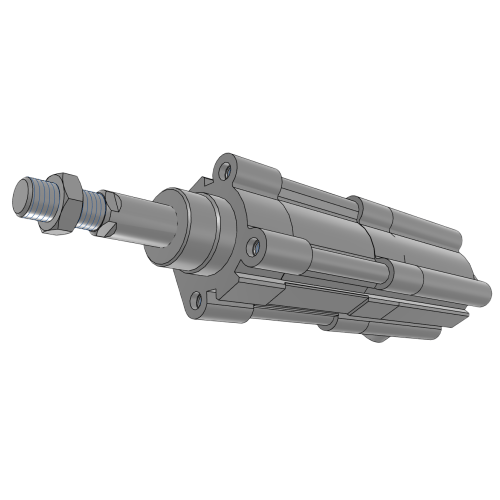
Airtac BSAID Clamp Cylinder BSAID125X75S
The AirTAC Airtac BSAID Clamp Cylinder BSAID125X75S is a genuine double-acting ISO 15552 cylinder with a Ø125mm bore, 75mm stroke and a spring-applied, air-released clamp-lock that holds the rod at ANY position along its travel — with a static holding force of 8600 N.
- BoreØ125 mm
- Stroke75 mm
- Cylinder portG1/2
- TypeDouble rod (BSAID)
- Enclasp portG1/8
- Rod threadM27×2
About the Airtac BSAID Clamp Cylinder BSAID125X75S
The AirTAC BSAID125X75-S is a double-acting ISO 15552 profile cylinder featuring a double-rod layout and an integrated spring-applied, air-released clamp-lock. It delivers a static holding force of 8600 N, gripping the rod securely at any position along its 75 mm travel. Because it is a double-rod unit, the thrust is equal in both directions at 5734 N (the pull-side value at 0.5 MPa). Remember that holding force and thrust are separate quantities: the 8600 N clamp resists an external static load, whereas the 5734 N thrust dictates the cylinder's motive power.
A rod extending from both ends allows you to mount a workpiece on one side and a counterweight, guide, or position flag on the opposite end, providing dual-side guidance and anti-rotation. This unit includes a magnet for CMSE reed and DMSE electronic sensors. The clamp requires a third G1/8 enclasp port to release the rod, and it operates within a 0.15-0.7 MPa range. Note that the variable air cushion only decelerates the piston near stroke end; the clamp itself is what actually holds the load.
Airtac BSAID Clamp Cylinder BSAID125X75S Technical Specifications
| Model | Airtac BSAID Clamp Cylinder BSAID125X75S |
|---|---|
| Series | BSAI ISO 15552 clamp-lock cylinder |
| Bore size | Ø125 mm |
| Stroke | 75 mm |
| Type | Double rod (BSAID), double acting |
| Cylinder port | G1/2 |
| Rod thread | M27×2 |
| Lock type | Spring-applied, air-released clamp (any position) |
|---|---|
| Static holding force | 8600 N |
| Enclasp / unlock port | G1/8 |
| Operating pressure | 0.15 – 0.7 MPa |
| Temperature | -20 to +70 °C |
| Speed range | 30 – 500 mm/s |
| Max stroke | Up to 1000 mm |
Specifications follow the official AirTAC BSAI datasheet (ISO 15552). Operating pressure is 0.15–0.7 MPa (lower than a plain SAI). Port options: PT / G.
How the Clamp-Lock Holds
static holding force (Ø125 mm)
A spring-applied gripper clamps the rod and holds the load at any position in the stroke — not just at the stroke end (that is a SAIL) — and it is bidirectional: it holds whether the rod was extending or retracting.
Theoretical Output Force (Ø125mm)
| Pressure | Push force | Pull force |
|---|---|---|
| 0.5 MPa | 6136 N | 5734 N |
| 0.7 MPa (max) | 8590 N | — |
Equal force both directions (double rod). Rated to the 0.7 MPa operating maximum for this series. The clamp holding force (8600 N) is separate from cylinder thrust. Size with a margin.
Where the Airtac BSAID Clamp Cylinder BSAID125X75S Is Used
Vertical Load Arresting
Holds heavy vertical payloads at any intermediate height with 8600 N of static force, preventing sudden drops during a pneumatic pressure loss.
Machining Position Hold
Locks the dual rods rigidly in place mid-stroke to withstand machining vibration or inspection forces without relying on live air pressure.
Dual-Side Tool Guidance
Uses the second rod end for a counterweight or guide rail, ensuring anti-rotation while the clamp secures the assembly anywhere in the travel.
Is the Airtac BSAID Clamp Cylinder BSAID125X75S the Right Clamp-Lock?
Choose this 125 mm bore model when an application demands extreme holding capacity and equal push/pull forces. If your load requires less motive force, stepping down to the 100 mm bore offers 3681 N thrust and a 5500 N holding force. Conversely, the BSAID125X75-S is the right pick when you need to lock mid-stroke rather than just at the end of travel, which is the primary distinction between this BSAI series and a SAIL end-lock cylinder. If you only need double-rod motion without position holding, a plain SAID cylinder suffices.
The clamp locks only after the cylinder has stopped; it cannot brake a moving rod. You must unlock it with balanced air pressures on both sides of the piston, or the rod may jump abruptly. For human-safety-critical loads, an additional independent safety measure is required. This PT-ported unit uses a 1/2 cylinder port, accepts Basic, FA, LB, TC, TCM1, and TCM2 mounts (omitting FB/CA/CB/CR due to the double rod), and its robust 32 mm rod with an M27x2 thread handles high side loads.
Quick checklist
- ✓ Hold needed at any position?
- ✓ Or stroke-end only → use SAIL
- ✓ Holding force ≥ your load
- ✓ Balanced-pressure unlock circuit
- ✓ Extra safety measure for people
Airtac BSAID Clamp Cylinder BSAID125X75S FAQ
It uses a spring-applied, air-released mechanism to grip the rod at any position with an 8600 N static holding force. It is bidirectional and engages after the cylinder stops; it cannot brake a moving rod.
You must apply balanced air pressure to both sides of the piston via the cylinder ports and supply air to the G1/8 enclasp port. Releasing the clamp with unbalanced pressures can cause the rod to jump abruptly.
Related AirTAC Lock & Standard Cylinders
Request a Quote for Airtac BSAID Clamp Cylinder BSAID125X75S
Send us the quantity and destination. We confirm price, stock and lead time — usually within 7-8 hours.