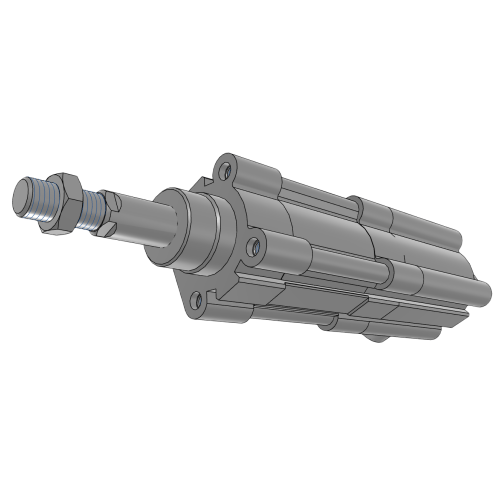
Airtac BSAID Clamp Cylinder BSAID63X150S
The AirTAC Airtac BSAID Clamp Cylinder BSAID63X150S is a genuine double-acting ISO 15552 cylinder with a Ø63mm bore, 150mm stroke and a spring-applied, air-released clamp-lock that holds the rod at ANY position along its travel — with a static holding force of 2200 N.
- BoreØ63 mm
- Stroke150 mm
- Cylinder portG3/8
- TypeDouble rod (BSAID)
- Enclasp portG1/8
- Rod threadM16×1.5
About the Airtac BSAID Clamp Cylinder BSAID63X150S
The AirTAC BSAID63X150-S is a double-acting ISO 15552 profile cylinder featuring a built-in spring-applied, air-released clamp-lock. It secures the piston rod at any position along its 150mm travel, providing a robust static holding force of 2200 N. Because this is a double-rod unit, thrust is equal in both directions at 1402 N (0.5 MPa), and the twin rods allow mounting a workpiece on one end and a guide or counterweight on the other for dual-side anti-rotation. Note that this 2200 N holding force is a distinct quantity from the cylinder thrust; you must size the clamp against the static load, not the pneumatic push force.
The clamp mechanism engages bidirectionally but locks only after the rod has stopped, meaning it cannot brake a moving load. Unlocking requires balanced air pressure on both sides of the piston via the dedicated G1/8 enclasp port, preventing abrupt rod jumps. Do not confuse the variable air cushion, which only decelerates the piston near stroke end, with the clamp that actually holds the load. This -S model includes a magnet for precise position sensing with AirTAC CMSE (reed) and DMSE (solid-state) switches.
Airtac BSAID Clamp Cylinder BSAID63X150S Technical Specifications
| Model | Airtac BSAID Clamp Cylinder BSAID63X150S |
|---|---|
| Series | BSAI ISO 15552 clamp-lock cylinder |
| Bore size | Ø63 mm |
| Stroke | 150 mm |
| Type | Double rod (BSAID), double acting |
| Cylinder port | G3/8 |
| Rod thread | M16×1.5 |
| Lock type | Spring-applied, air-released clamp (any position) |
|---|---|
| Static holding force | 2200 N |
| Enclasp / unlock port | G1/8 |
| Operating pressure | 0.15 – 0.7 MPa |
| Temperature | -20 to +70 °C |
| Speed range | 30 – 800 mm/s |
| Max stroke | Up to 1000 mm |
Specifications follow the official AirTAC BSAI datasheet (ISO 15552). Operating pressure is 0.15–0.7 MPa (lower than a plain SAI). Port options: PT / G.
How the Clamp-Lock Holds
static holding force (Ø63 mm)
A spring-applied gripper clamps the rod and holds the load at any position in the stroke — not just at the stroke end (that is a SAIL) — and it is bidirectional: it holds whether the rod was extending or retracting.
Theoretical Output Force (Ø63mm)
| Pressure | Push force | Pull force |
|---|---|---|
| 0.5 MPa | 1559 N | 1402 N |
| 0.7 MPa (max) | 2182 N | — |
Equal force both directions (double rod). Rated to the 0.7 MPa operating maximum for this series. The clamp holding force (2200 N) is separate from cylinder thrust. Size with a margin.
Where the Airtac BSAID Clamp Cylinder BSAID63X150S Is Used
Vertical Axis Drop Prevention
Holds a lifted load securely at any intermediate height during power loss, preventing sudden falls on vertical transfer lines.
Machining Position Hold
Locks the double-rod assembly rigidly mid-stroke to withstand cutting forces during clamping, milling, or inspection operations.
Dual-Side Tooling Actuation
Uses one rod end for the primary workpiece and the opposite end to mount a counterweight or position flag for guided anti-rotation.
Is the Airtac BSAID Clamp Cylinder BSAID63X150S the Right Clamp-Lock?
Choose this 63mm bore double-rod model when an application requires equal force both ways and multi-sided mounting. If you need more holding power, the 80mm bore offers 3600 N holding force and 2268 N thrust at 0.5 MPa; if less is required, the 50mm bore provides 1400 N holding force and 825 N thrust. Select BSAID over SAIL when you need to lock at any position rather than just at stroke ends, or choose a plain SAID if clamping is unnecessary. For replacement, verify the 150mm stroke, 3/8 PT cylinder ports, and the double-rod mounting set (Basic, FA, LB, TC, TCM1, TCM2), noting that double-rod variants omit the FB, CA, CB, and CR mounts.
Always apply the clamp strictly after the cylinder stops, as it is not a dynamic brake. Ensure pressures are balanced before unlocking to avoid sudden rod movement. For safety-critical loads, install an independent external safety measure. The 20mm rod diameter and M16x1.5 thread provide excellent rigidity, though strokes of 300mm or more require external guide support.
Quick checklist
- ✓ Hold needed at any position?
- ✓ Or stroke-end only → use SAIL
- ✓ Holding force ≥ your load
- ✓ Balanced-pressure unlock circuit
- ✓ Extra safety measure for people
Airtac BSAID Clamp Cylinder BSAID63X150S FAQ
The integrated clamp-lock provides a static holding force of 2200 N. It engages via spring pressure to hold the rod bidirectionally at any position along the stroke, but only after the cylinder has come to a complete stop.
The clamp is released by applying 0.15-0.7 MPa of air to the dedicated G1/8 enclasp port. You must balance the air pressures on both sides of the piston before unlocking, otherwise the rod can move abruptly. An independent safety measure is required for human-safety loads.
Related AirTAC Lock & Standard Cylinders
Request a Quote for Airtac BSAID Clamp Cylinder BSAID63X150S
Send us the quantity and destination. We confirm price, stock and lead time — usually within 7-8 hours.