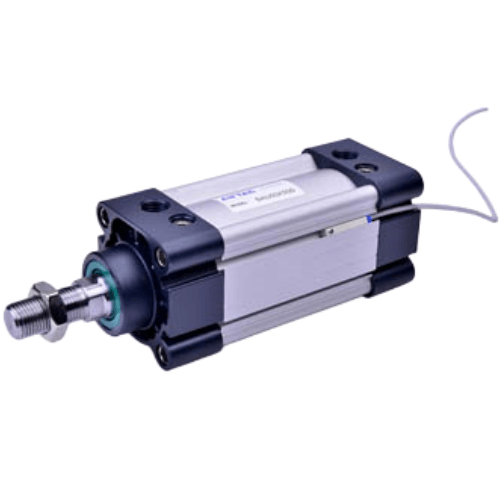
Airtac SAUD Double Rod Cylinder SAUD80X550
The AirTAC SAUD Double Rod Cylinder SAUD80X550 is a genuine double-acting profile-type standard air cylinder with a Ø80mm bore and 550mm stroke, 3/8" air ports and adjustable end cushioning. Its hard-anodized aluminum-profile barrel is shorter than an ISO 15552 cylinder of the same bore, and it shares SC-series mounting accessories.
- BoreØ80 mm
- Stroke550 mm
- Port size3/8"
- Acting typeDouble acting
- Rod threadM20×1.5
- CushionAdjustable, 28 mm
- No minimum order. A single piece can be ordered.
- Ready in 3–5 business days. That is the time we take to process the order and hand it to the carrier. Transit time after that depends on the destination.
About the Airtac SAUD Double Rod Cylinder SAUD80X550
The AirTAC SAUD80X550 is a double-acting, double-rod profile cylinder with an 80 mm bore and 550 mm stroke. Because a rod exits both ends, the output is 2268 N each way at 0.5 MPa, matching the pull-side figure exactly. The extruded aluminium barrel keeps the body shorter than an ISO 15552 unit of the same bore. It uses a 3/8" port, an M20x1.5 rod thread, and adjustable 28 mm air cushions at both ends.
The twin rods prevent rotation and can drive dual tools simultaneously. This SKU lacks a magnet, so it cannot accept position switches. For high-heat duties up to 150 C, specify the Viton H seal option.
Airtac SAUD Double Rod Cylinder SAUD80X550 Technical Specifications
| Model | Airtac SAUD Double Rod Cylinder SAUD80X550 |
|---|---|
| Series | SAU profile-type cylinder |
| Bore size | Ø80 mm |
| Stroke | 550 mm |
| Acting type | Double acting |
| Port size | 3/8" |
| Rod thread | M20×1.5 |
| Fluid | Air (filtered by 40µm element) |
|---|---|
| Operating pressure | 0.15 – 1.0 MPa |
| Proof pressure | 1.5 MPa |
| Temperature | -20 to +70 °C |
| Speed range | 30 – 800 mm/s |
| Cushion | Adjustable, 28 mm |
| Max stroke | Up to 1500 mm |
Specifications follow the official AirTAC SAU series datasheet. Confirm against the product label before installation. Thread options: PT (blank) / G (BSPP). A high-temperature seal (0-150 °C) is available.
Theoretical Output Force (Ø80mm)
| Pressure | Push force | Pull force |
|---|---|---|
| 0.5 MPa | 2268 N | 2268 N |
| 0.7 MPa | 3175 N | — |
| Max (@1.0 MPa) | 463 kgf | |
Double-rod model: the rod passes through the rear cover, so both piston faces lose rod area and push is shown at the annular-area value. Actual usable force is lower than theoretical due to friction and back-pressure. Size with a safety margin.
Model Code: Airtac SAUD Double Rod Cylinder SAUD80X550
| SAU | Profile-type standard cylinder series. |
|---|---|
| 80 | Bore size in mm. |
| ×550 | Stroke length in mm. |
| -S | Optional built-in magnet for sensor position sensing. |
Related SAU-family variants: SAUD (double rod), SAUJ (adjustable stroke), SAUF (with built-in solenoid valve), and SAU-S with built-in magnet. Seals: TPU (blank) / Viton H / NBR N. Sensor switches: CMSG / DMSG / EMSG.
Where the Airtac SAUD Double Rod Cylinder SAUD80X550 Is Used
Twin-Tool Stamping
Drives two matched forming tools simultaneously from opposite rod ends, ensuring perfectly synchronized contact on the workpiece.
Anti-Rotation Clamping
Holds and releases heavy machined parts without piston twist, maintaining precise alignment during multi-axis milling operations.
Balanced Vertical Press
Applies 2268 N of equal downward and upward force for pressing bearings, preventing asymmetric load drift on the fixture.
Is the Airtac SAUD Double Rod Cylinder SAUD80X550 the Right Cylinder?
Choose this 80 mm bore delivering 2268 N equal force when your mechanism requires anti-rotation guidance or twin tooling. If you need less power, the 63 mm bore provides 1402 N both ways; if you need more, the 100 mm bore offers 3681 N. Mounting is limited to Basic, FA flange, and LB foot styles compatible with the AirTAC SC series. At 550 mm stroke, external guides are strongly recommended to prevent rod bending under side loads. Because this unit has no magnet, select a -S variant if you need CMSG or DMSG sensors. Note that a plain cylinder drifts on air loss; use an external rod lock for held loads.
Quick checklist
- ✓ Required force at your working pressure
- ✓ Stroke and mounting space
- ✓ Port/thread type (PT/G)
- ✓ Magnet (-S) for sensors?
- ✓ Side load — consider a guided cylinder
Installation & Maintenance Notes
- check Use clean air filtered to 40µm or finer.
- check Keep within 0.15 – 1.0 MPa operating pressure.
- check Avoid side load on the piston rod.
- check Adjust end cushion screws for smooth stops.
- check Use correct mounting accessory (FA/FB/CA/CB/LB — same as SC).
- check Installation by qualified personnel per AirTAC docs.
Airtac SAUD Double Rod Cylinder SAUD80X550 FAQ
The force is equal in both directions because it is a double-rod design. It produces 2268 N at 0.5 MPa, 3175 N at 0.7 MPa, and 4082 N at 0.9 MPa. The 3/8" port and 28 mm cushions handle the 30-800 mm/s speed range.
No, this specific SKU does not include a magnet, so it cannot accept CMSG, DMSG, or EMSG switches. You must order a -S version of the SAUD cylinder to enable magnetic sensing on the profile barrel.
Authorized Export Seller
Genuine AirTAC parts produced by AirTAC factory.
1-Year Warranty
Covers non-human-caused product damage.
Fast Dispatch
Standard models are processed and dispatched in 3-5 business days.
Fast Reply
Most inquiries answered within 7-8 hours.
Request a Quote for Airtac SAUD Double Rod Cylinder SAUD80X550
Send us the quantity and destination. We confirm price, stock and lead time — usually within 7-8 hours.