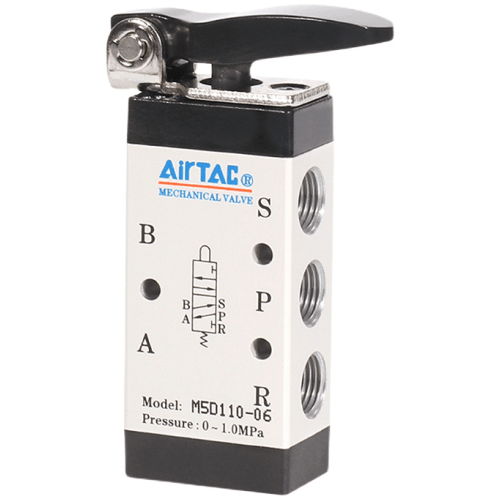
Airtac M5D Short Handle Type Mechanical Valve M5D21008
Mechanically actuated · no coil, no pilot airThe AirTAC Airtac M5D Short Handle Type Mechanical Valve M5D21008 is a genuine 5/2-way short handle type control valve. A short hand lever where panel depth is limited. It is an external control, direct-acting valve - the spool is moved mechanically, so there is nothing to wire and no pilot line to plumb. Ports are PT1/4 with a 12.0 mm2 (Cv 0.67) effective area.
$30.93 $35.38Save 12%- No minimum order. A single piece can be ordered.
- Ready in 3–5 business days. That is the time we take to process the order and hand it to the carrier. Transit time after that depends on the destination.
Specifications
| Model | M5D21008 |
|---|---|
| Valve type | 5/2 way, external control, direct acting |
| Actuation | Short handle type |
| Reset | Automatic (spring) restoration |
| Body series | 200 Series, single control |
| Port size | PT1/4 |
| Effective area | 12.0 mm2 (Cv 0.67) |
| Fluid | Air, filtered by a 40 um element |
|---|---|
| Pressure range | 0 - 1.0 MPa (0 - 145 psi) |
| Proof pressure | 1.5 MPa (215 psi) |
| Temperature | -20 to +70 C |
| Body material | Aluminium alloy |
| Lubrication | Not required |
| Thread standard | PT (Rc tapered) |
| Spool stroke | 2.0-3.0 mm |
| Actuator stroke | 5.5-8.0 mm at the handle |
Sliding-column (spool) construction, so operating force is not affected by working pressure - there is no back-pressure effect. Lubrication is not required, but once the valve has been run on lubricated air it must stay on lubricated air; AirTAC suggests ISO VG32 or equivalent. The short handle type control set is METAL, which gives a longer service life than the engineering-plastic heads. The exhaust outlet sits on top of the body, so a silencer fits directly.
About the M5D21008
The M5D21008 is a 5/2-way external control, direct acting valve that is thrown by hand, not by a coil. There is no solenoid, no pilot port and no wiring: a short lever on top of the 200-series body is pushed by an operator's finger or thumb, and a spring snaps the spool back the moment the lever is released. That makes it the right part for manual stations on machines that carry no electrical supply, or where a bare-hand override is wanted next to an automated circuit.
The short handle is AirTAC's compact lever: at 5.5-8.0 mm of travel it throws the spool with less reach than the long C-handle, so it suits shallow control panels and tight operator stations. The 210 body carries 1/4in PT ports and a 12.0 mm2 effective orifice (Cv 0.67), and because the sliding-column spool is mechanically thrown, the control force is not affected by working pressure - changeover feels the same at 0.2 MPa as it does at 1.0 MPa. The metal control set gives stable long-term switching, and the exhaust outlet sits on top of the body so a silencer screws straight on without an elbow.
Typical applications
Manual jog station on a packaging machine
Bolted to the frame of a carton-sealing line, the short handle lets an operator inch the conveyor forward during changeover without opening an electrical cabinet - the spring return dumps the signal the instant the lever is let go, so the machine cannot be left enabled.
Clamp fixture on a woodworking bench
Piped to a pneumatic hold-down cylinder on a jig table, the D lever applies and releases the clamp by hand at the start and end of each pass, and the 1/4in PT ports feed the cylinder fast enough for repeatable cycles.
Panel-mounted divert valve in a test rig
Flush-mounted into the face plate of a hydraulic-style test bench, the short handle switches supply between two actuators of a leak-test fixture. Panel mounting is supported as standard, so the lever sits flush and cannot be snagged.
How to choose
The choice you are most likely weighing is D against C: both are spring-return hand levers on the same 210 body. Pick the D short handle when the valve lives on a shallow panel face or inside a guard where a long lever would foul; pick the C long handle when the operator needs reach or leverage, since its 11.0-16.0 mm travel gives a more deliberate throw. If the valve must hold its position after the hand leaves it, you need the Y lever or HS selector instead - both are manual-restoration types, unlike this spring-return D.
On sizing: the 210 body with 1/4in ports flows 12.0 mm2 (Cv 0.67), while the smaller 110 body at 1/8in flows 8.0 mm2 (Cv 0.45). Step up to this model when your cylinder bore needs the extra flow. Do not exceed the published reversal stroke: spool stroke 2.0-3.0 mm, actuator (handle) stroke 5.5-8.0 mm. Beyond those limits the valve damages, and AirTAC states this explicitly in the datasheet.
Frequently asked questions
It is a 5/2-way external control, direct acting valve with a short spring-return handle. Ports are PT1/4 on the 200-series aluminium body, with an effective area of 12.0 mm2 (Cv 0.67). Pressure range is 0-1.0 MPa (0-145 psi), proof pressure 1.5 MPa (215 psi), and operating temperature -20 to +70 C. Air is filtered by a 40 um element; lubrication is not required, but if lubricated air is used, continue with the same medium (ISO VG32 or equivalent) for best valve life.
The published reversal stroke is 2.0-3.0 mm at the spool and 5.5-8.0 mm at the handle. Those are limits, not targets: exceeding them damages the valve, and AirTAC says so explicitly in the datasheet. If your application needs a harder or longer throw, fit a stroke-limiting cam or choose the long C handle instead - do not drive the short handle past its travel.