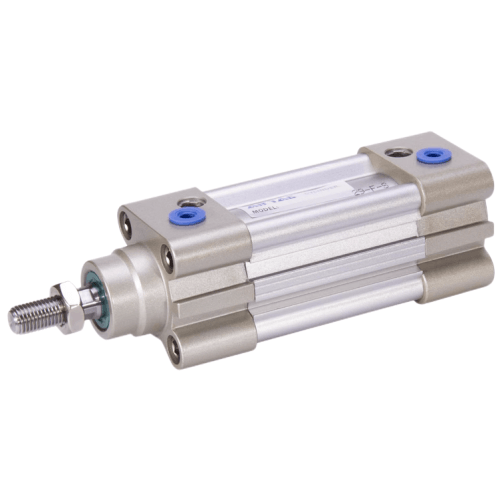
Airtac SAI200 Standard Cylinder SAI200AX155
The AirTAC Airtac SAI200 Standard Cylinder SAI200AX155 is a genuine double-acting ISO 15552 profile-barrel air cylinder with a Ø200mm bore and 155mm stroke, G3/4 air ports and adjustable end cushioning. Its standardized mounting interface makes it a drop-in replacement for other ISO 15552 cylinders in automation lines.
- BoreØ200 mm
- Stroke155 mm
- Port sizeG3/4
- Acting typeDouble acting
- Rod threadM36×2
- CushionAdjustable, 50 mm
About the Airtac SAI200 Standard Cylinder SAI200AX155
The AirTAC SAI200X155 is a double-acting profile cylinder built to ISO 15552 mounting dimensions, providing a massive 15708 N push force at 0.5 MPa and a peak of 3204 kgf at 1.0 MPa. This 200 mm bore, 155 mm stroke configuration is engineered for heavy-duty machinery requiring immense thrust and a compact mid-stroke reach.
Unlike standard carbon steel rods, this specific unit features a SUS420J2 stainless steel rod (material code A) for superior corrosion and scratch resistance. The barrel utilizes extruded aluminum with sensor grooves on both sides for CMSE or DMSE switches, though a -S magnet option is required to enable them.
Airtac SAI200 Standard Cylinder SAI200AX155 Technical Specifications
| Model | Airtac SAI200 Standard Cylinder SAI200AX155 |
|---|---|
| Series | SAI ISO 15552 profile cylinder |
| Bore size | Ø200 mm |
| Stroke | 155 mm |
| Acting type | Double acting |
| Port size | G3/4 |
| Rod thread | M36×2 |
| Fluid | Air (filtered by 40µm element) |
|---|---|
| Operating pressure | 0.15 – 1.0 MPa |
| Proof pressure | 1.5 MPa |
| Temperature | -20 to +70 °C |
| Speed range | 30 – 500 mm/s |
| Cushion | Adjustable, 50 mm |
| Max stroke | Up to 1500 mm |
Specifications follow the official AirTAC SAI series datasheet and ISO 15552 dimensions. Confirm against the product label before installation. Port options: G (BSPP) / NPT.
Theoretical Output Force (Ø200mm)
| Pressure | Push force | Pull force |
|---|---|---|
| 0.5 MPa | 15708 N | 15080 N |
| 0.7 MPa | 21991 N | — |
| Max (@1.0 MPa) | 3204 kgf | |
Actual usable force is lower than theoretical due to friction and back-pressure. Size with a safety margin.
Model Code: Airtac SAI200 Standard Cylinder SAI200AX155
| SAI | ISO 15552 profile-barrel cylinder series. |
|---|---|
| 200 | Bore size in mm. |
| ×155 | Stroke length in mm. |
| -S | Optional built-in magnet for sensor position sensing. |
Related SAI-family variants: SAID (double rod), SAIJ (adjustable stroke), SAIL (with lock), SAIF (with valve), BSAI (enclasp / clamp-lock), and SAI-S with built-in magnet. Rod material: carbon steel (blank) / SUS420J2 (A) / SUS304 (B); seals: TPU (blank) / Viton H / NBR N.
Where the Airtac SAI200 Standard Cylinder SAI200AX155 Is Used
Heavy Metal Forming
Generates the 21991 N push force at 0.7 MPa required to actuate large mechanical presses and bend thick sheet metal components.
Injection Molding Extraction
Provides the robust, high-thrust extraction power needed to pull heavy, dense plastic automotive interior panels from large injection molds.
Large Press Demolding
Delivers reliable, high-tonnage ejection strokes for removing solid composite or dense rubber parts from deep industrial press molds.
Is the Airtac SAI200 Standard Cylinder SAI200AX155 the Right Cylinder?
Selecting this 200 mm bore is ideal when 160 mm (10053 N at 0.5 MPa) cannot generate enough push force for your heaviest loads. If you need less force, dropping down to a 160 mm bore saves space and air consumption. This model uses PT tapered port threads and a G3/4 fluid port size.
Because the stroke is 155 mm, side-load bending on the rod bearing is minimal compared to longer strokes, but heavy loads still require precise alignment. A plain SAI relies entirely on live air pressure to move; if your system loses air, the piston will drift and drop the load. For suspended loads that must stay put during pressure loss, specify the SAIL (air-released lock) or BSAI (bidirectional clamp-lock) variant.
Quick checklist
- ✓ Required force at your working pressure
- ✓ Stroke and mounting space
- ✓ Port/thread type (PT/NPT/G)
- ✓ Magnet (-S) for sensors?
- ✓ Side load — consider a guided cylinder
Installation & Maintenance Notes
- check Use clean air filtered to 40µm or finer.
- check Keep within 0.15 – 1.0 MPa operating pressure.
- check Avoid side load on the piston rod.
- check Adjust end cushion screws for smooth stops.
- check Use correct mounting accessory (FA/FB/CA/CB/LB/TC).
- check Installation by qualified personnel per AirTAC docs.
Airtac SAI200 Standard Cylinder SAI200AX155 FAQ
At 0.5 MPa, it provides 15708 N of push force and 15080 N of pull force. At 0.7 MPa, the push force increases to 21991 N, with a theoretical maximum of 3204 kgf at 1.0 MPa.
The SAI200X155 is dimensionally interchangeable per ISO 15552, meaning it matches the standard mounting interface of other ISO 15552 profile cylinders. Always verify your specific mounting dimensions and port locations before swapping components.
Authorized Export Seller
Genuine AirTAC parts produced by AirTAC factory.
1-Year Warranty
Covers non-human-caused product damage.
Fast Dispatch
Standard models usually ship in 3-4 days.
Fast Reply
Most inquiries answered within 7-8 hours.
Related AirTAC SAI Cylinders
Request a Quote for Airtac SAI200 Standard Cylinder SAI200AX155
Send us the quantity and destination. We confirm price, stock and lead time — usually within 7-8 hours.