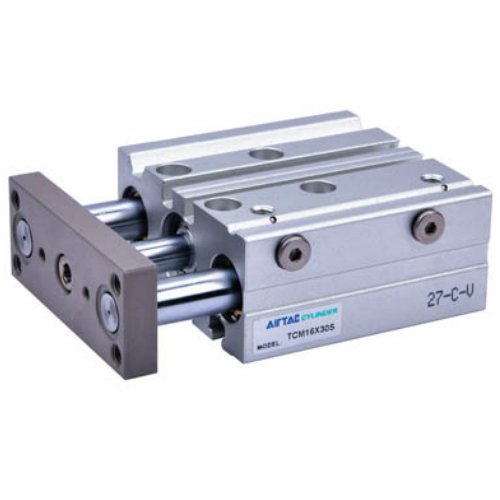
Airtac TCM Triple Axis Cylinder TCM16X100SH
The AirTAC TCM Triple Axis Cylinder TCM16X100SH is a genuine JIS-standard guided cylinder with a Ø16mm bore and 100mm stroke on twin guide rods. Its integrated brass sliding bearing gives high radial-load and impact resistance — about double the horizontal impact tolerance of a plain cylinder, holding the tool square to ±0.09° of rotation without any external linear guide.
- BoreØ16 mm
- Stroke100 mm
- Port sizeM5×0.8
- BearingBrass sliding bearing
- Non-rotating±0.09°
- CushionRubber bumper
- No minimum order. A single piece can be ordered.
- Ready in 3–5 business days. That is the time we take to process the order and hand it to the carrier. Transit time after that depends on the destination.
About the Airtac TCM Triple Axis Cylinder TCM16X100SH
The AirTAC TCM16X100SH is a JIS-standard twin-rod guided cylinder configured for double-acting operation. An integrated brass sliding bearing supports the drive piston, yielding 101 N of push and 75 N of pull at 0.5 MPa. This design eliminates the need to align a separate linear rail, saving engineering time. The twin guide rods hold a tight ±0.09° non-rotating tolerance, keeping a gripper or blade square under off-centre loads up to the stroke's safe limit.
Built for harsh environments, the brass sleeve shrugs off dust, grit, and hard knocks—offering roughly twice the horizontal impact resistance of a plain cylinder. A standard built-in magnet works with CS1 reed or DS1 electronic switches in the four body slots. Stroke terminations are absorbed by fixed elastomer pads rather than an adjustable cushion screw. The Viton (FKM) seals extend the working temperature range, and the Ø8 mm piston rod feeds through M5x0.8 PT ports.
Airtac TCM Triple Axis Cylinder TCM16X100SH Technical Specifications
| Model | Airtac TCM Triple Axis Cylinder TCM16X100SH |
|---|---|
| Series | TCM JIS guided (twin-rod) cylinder |
| Bore size | Ø16 mm |
| Stroke | 100 mm |
| Acting type | Double acting |
| Bearing | Brass sliding bearing |
| Port size | M5×0.8 |
| Fluid | Air (filtered by 40µm element) |
|---|---|
| Operating pressure | 0.15 – 1.0 MPa |
| Proof pressure | 1.5 MPa |
| Temperature | -20 to +70 °C |
| Speed range | 30 – 500 mm/s |
| Non-rotating tolerance | ±0.09° (retracted) |
| Cushion | Rubber bumper |
| Max std stroke | Up to 200 mm |
Specifications follow the official AirTAC TCL/TCM series datasheet (JIS standard). Confirm against the product label before installation. Thread options: PT (blank) / G / NPT. Every TC model ships with a built-in magnet for sensor switches.
Theoretical Output Force (Ø16mm)
| Pressure | Push force | Pull force |
|---|---|---|
| 0.5 MPa | 101 N | 75 N |
| 0.7 MPa | 141 N | — |
| Max | 21 kgf | |
Force is set by the bore and piston rod (Ø8 mm); the twin guide rods carry side load and torque, not thrust. Actual usable force is lower than theoretical due to friction and back-pressure.
Model Code: Airtac TCM Triple Axis Cylinder TCM16X100SH
| TC | Tri-rod (guided, twin-rod) cylinder, double acting. |
|---|---|
| M | Bearing: Brass sliding bearing (M = brass sliding). |
| 16 | Bore size in mm. |
| ×100 | Stroke length in mm. |
| S | Built-in magnet (standard on TC) for a magnetic sensor switch. |
Sister type: TCL16X100 (steel-ball linear bearing, lower friction & higher precision). Thread codes: blank = PT · G · T = NPT.
Where the Airtac TCM Triple Axis Cylinder TCM16X100SH Is Used
Foundry Sand-Mould Pusher
Tolerates abrasive grit and high ambient heat via FKM seals, using its 141 N of 0.7 MPa thrust to compact sand moulds where a ball bearing would rapidly jam.
Dusty Transfer Line Diverter
The brass sliding sleeve survives airborne dust while the twin rods maintain ±0.09° rotational accuracy to keep the diverter gate perfectly aligned during 100 mm strokes.
Off-Centre Part Ejector
Absorbs the radial load of pushing asymmetric components off a press bed, delivering 75 N of retraction force without requiring an external guide rail.
Is the Airtac TCM Triple Axis Cylinder TCM16X100SH the Right Cylinder?
If 101 N of thrust at 0.5 MPa is slightly excessive for your layout, stepping down to the Ø12 bore yields 57 N of push. Conversely, scaling up to the Ø20 bore provides 157 N. Choose the sibling TCL series with its steel-ball linear bearing instead of this brass sleeve if your task demands ultra-low friction or high vertical precision. To replicate this exact unit, match the 16 mm bore, 100 mm stroke, M5x0.8 PT ports, and the standard S magnet.
Remember that this guided unit resists rotation, not gravity; the rod will drift if air pressure drops. Incorporate an external rod lock or pilot-operated check valve for fail-safe load holding. Because 100 mm falls within the 200 mm standard limit, this is a stock stroke configuration.
Quick checklist
- ✓ Required force at your working pressure
- ✓ Side load / torque the guide must carry
- ✓ TCL (precision, low friction) vs TCM (impact, radial load)
- ✓ Stroke & mounting face (top / bottom / rear)
- ✓ Port/thread type (PT/NPT/G)
Installation & Maintenance Notes
- check Use clean air filtered to 40µm or finer.
- check Keep within 0.15 – 1.0 MPa operating pressure.
- check The guide unit takes side load & torque — but do not exceed the max safe load/torque for your stroke.
- check Mount from the top, bottom (screw or T-slot) or rear face; use the precision locating holes.
- check Do not disassemble the fixing block or guide unit — factory-set precision.
- check Fit CS1 / DS1 magnetic switches in the four sensor slots as needed.
Airtac TCM Triple Axis Cylinder TCM16X100SH FAQ
At 0.5 MPa, this 16 mm bore cylinder generates 101 N of push and 75 N of pull. At the maximum operating pressure of 1.0 MPa, the push increases to 141 N, with a theoretical maximum force of 21 kgf.
Each end of the stroke lands on a fixed TPU bumper. There is no adjustable air cushion or cushion screw to tune; the elastomer pads simply absorb the impact to protect the mechanism.
Authorized Export Seller
Genuine AirTAC parts produced by AirTAC factory.
1-Year Warranty
Covers non-human-caused product damage.
Fast Dispatch
Standard models are processed and dispatched in 3-5 business days.
Fast Reply
Most inquiries answered within 7-8 hours.
Related AirTAC TCM Cylinders
Request a Quote for Airtac TCM Triple Axis Cylinder TCM16X100SH
Send us the quantity and destination. We confirm price, stock and lead time — usually within 7-8 hours.