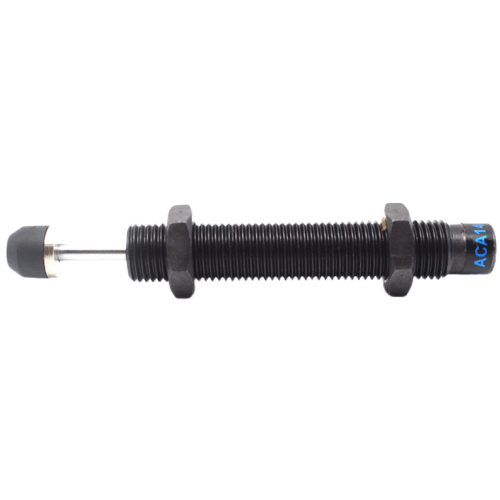
Airtac ACA Standard Automatic Compensation Hydraulic Shock Absorber ACA2025-1F
Genuine AirTAC hydraulic shock absorber, order code ACA2025-1F from the ACA20 range. The options this code selects are decoded below; series data follow the official AirTAC catalog.
- ModelACA2025 (25 mm stroke)
- Speed range1: high speed, light load
- CapSteel cap (F)
- TypeSelf-compensating, speed type 1/2/3
- Body threadM20×1.5
- ACA202020 mm · 60 J/cycle · 50,000 J/h · max. mass 240 / 660 / 960 kg (type 1/2/3) · 175 g
- No minimum order. A single piece can be ordered.
- Ready in 3–5 business days. That is the time we take to process the order and hand it to the carrier. Transit time after that depends on the destination.
About the Airtac ACA Standard Automatic Compensation Hydraulic Shock Absorber ACA2025-1F
The F at the end of ACA2025-1F is the ordering-code position for the cap, and here it means steel: a metal cap on the rod end that stands up to heavier impact faces than the standard plastic one. The absorber itself is the 25 mm stroke member of the ACA20 series, self-compensating so braking resistance matches each impact without adjustment. Type 1 covering high speed, light load means speeds up to 4 m/s and effective masses up to 260 kg, with 65 J per cycle absorbed at up to 54,000 J/h.
Like the rest of the series it carries an M20x1.5 fully threaded body that mounts easily, adjusts along its thread and sheds heat, a hardened stainless steel piston rod, and a one-piece body rated from -5 to +70 C. Keep the striking face square to the rod (side load 3 degrees or less) and set the stop nut to stop the load 1 mm before the rod bottoms out for a long service life.
Airtac ACA Standard Automatic Compensation Hydraulic Shock Absorber ACA2025-1F Technical Specifications
| Order code | ACA2025-1F |
|---|---|
| Product | Hydraulic Shock Absorber |
| Model | ACA2025 (25 mm stroke) |
| Speed range | 1: high speed, light load |
| Cap | Steel cap (F) |
| Type | Self-compensating, speed type 1/2/3 |
|---|---|
| Body thread | M20×1.5 |
| ACA2020 | 20 mm · 60 J/cycle · 50,000 J/h · max. mass 240 / 660 / 960 kg (type 1/2/3) · 175 g |
| ACA2025 | 25 mm · 65 J/cycle · 54,000 J/h · max. mass 260 / 720 / 1040 kg (type 1/2/3) · 185 g |
| ACA2030 | 30 mm · 70 J/cycle · 58,000 J/h · max. mass 280 / 780 / 1120 kg (type 1/2/3) · 210 g |
| ACA2040 | 40 mm · 80 J/cycle · 65,000 J/h · max. mass 320 / 890 / 1280 kg (type 1/2/3) · 225 g |
| Max impact speed | 4 m/s (type 1), 2 m/s (2), 1 m/s (3) |
| Temperature | -5 to +70 °C |
| Side load angle | 3° or less |
| Piston rod | Hardened stainless steel |
| Accessories | Stop nut, flange |
Source: AirTAC Products Catalog 2026A (PDF01-P0779..P0783), ACA/ACJ series specifications, ordering code and usage notes.
How to choose
Choose ACA2025-1F when your duty is fast and light but the striking surface or fixture justifies a steel cap: the -1 type brakes up to 4 m/s at up to 260 kg effective mass, while -2 and -3 on the same 25 mm body handle 720 kg at 2 m/s and 1040 kg at 1 m/s. Against the plastic-cap ACA2025-1 you keep identical energy figures (65 J/cycle, 54,000 J/h) and gain a steel cap for heavier impacts; the ACA2025-1N has no cap at all. If 25 mm of stroke or 65 J is short, ACA2030-1 and ACA2040-1 reach 70 J and 80 J. Stay within 20 to 80 percent of maximum energy as AirTAC recommends.
Applications
Cylinder end-of-stroke damping
Mounted at the end of a fast, lightly loaded cylinder stroke, the type 1 range takes impact speeds up to 4 m/s while the steel cap resists the harder strike face.
Clamping and indexing units
Indexing pallets or clamping slides that arrive quickly benefit from self-compensating braking up to 65 J per cycle, with the stop nut acting as a positive end stop.
Machine fixtures with metal strikers
Where the moving part contacts the rod through a metal anvil, the F steel cap on the M20x1.5 threaded body holds up cycle after cycle under the 54,000 J/h rate.
FAQ
What figures define the ACA2025-1F at a glance?
25 mm stroke, 65 J/cycle maximum energy absorption, 54,000 J/h rate, M20x1.5 fully threaded body, steel cap (F in the code). Type 1: up to 4 m/s impact speed and 260 kg effective mass, versus 720 kg (type 2) and 1040 kg (type 3) on the same body. Temperature -5 to +70 C, side load 3 degrees or less.
Does the steel cap change the performance compared with other ACA2025 caps?
No. Energy, speed range and mass limits come from the 25 mm body and the -1 speed type, so 65 J per cycle at up to 4 m/s applies whether the cap is plastic (ACA2025-1), steel (ACA2025-1F) or absent (ACA2025-1N). The F cap is the durability choice for heavier impact faces; keep side load within 3 degrees whichever cap you use.