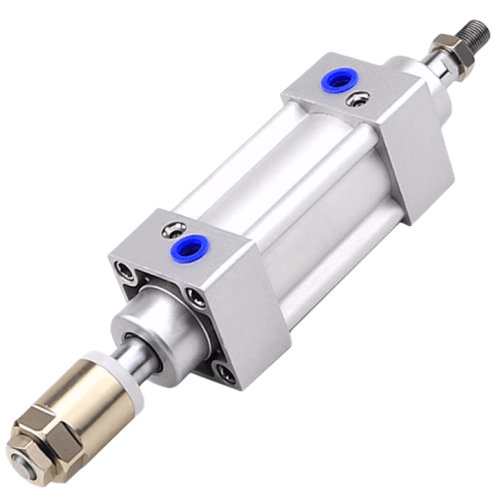
Airtac JSIJ100~125 Adjustable Cylinder JSIJ100X250-20
The AirTAC JSIJ100~125 Adjustable Cylinder JSIJ100X250-20 is a genuine double acting, double rod, adjustable stroke JIS-standard air cylinder with a Ø100mm bore and 250mm stroke, G1/2 air ports and adjustable end cushioning. Its no-tie-rod, hard-anodized profile barrel is more compact than an ISO 15552 cylinder of the same bore — a space-saver on tight machines.
- BoreØ100 mm
- Stroke250 mm
- Port sizeG1/2
- Acting typeDouble acting, double rod, adjustable stroke
- Rod threadM26×1.5
- CushionAdjustable, 33 mm
- No minimum order. A single piece can be ordered.
- Ready in 3–5 business days. That is the time we take to process the order and hand it to the carrier. Transit time after that depends on the destination.
About the Airtac JSIJ100~125 Adjustable Cylinder JSIJ100X250-20
The nominal 250 mm stroke remains the maximum, yielding a usable extend range of 230 to 250 mm, while the retract end stays fixed. The hard-anodized aluminium barrel omits tie rods entirely, making the body noticeably shorter and more compact than a same-bore ISO 15552 cylinder.
Air connects via a G1/2 port, driving a 32 mm piston rod with an M26x1.5 thread and 33 mm adjustable air cushions at both ends. Because this specific SKU lacks the -S magnet option, it cannot accept CMSE or DMSE sensors for position detection. Note that the cushions only decelerate the load near the stroke ends; a plain cylinder drifts on air loss, so fit an external rod lock or pilot-operated check valve if you need to hold a load securely.
Airtac JSIJ100~125 Adjustable Cylinder JSIJ100X250-20 Technical Specifications
| Model | Airtac JSIJ100~125 Adjustable Cylinder JSIJ100X250-20 |
|---|---|
| Series | JSI JIS-standard profile cylinder |
| Bore size | Ø100 mm |
| Stroke | 250 mm |
| Acting type | Double acting, double rod, adjustable stroke |
| Port size | G1/2 |
| Rod thread | M26×1.5 |
| Fluid | Air (filtered by 40µm element) |
|---|---|
| Operating pressure | 0.15 – 1.0 MPa |
| Proof pressure | 1.5 MPa |
| Temperature | -20 to +70 °C |
| Speed range | 30 – 800 mm/s |
| Cushion | Adjustable, 33 mm |
| Max standard stroke | Up to 1500 mm |
Specifications follow the official AirTAC JSI (JIS standard) datasheet. Confirm against the product label before installation. Thread options: PT (blank) / G. Barrel: hard-anodized aluminum profile (no tie rods).
Theoretical Output Force (Ø100mm)
| Pressure | Push force | Pull force |
|---|---|---|
| 0.5 MPa | 3525 N | 3525 N |
| 0.7 MPa | 4935 N | 4935 N |
| Max (@1.0 MPa) | 719 kgf | |
JSIJ is double-rod: the rear rod that carries the stroke adjuster passes through the rear cover, so both piston faces lose rod area. Push is shown at the annular-area value (conservative).
Model Code: Airtac JSIJ100~125 Adjustable Cylinder JSIJ100X250-20
| JSIJ | JIS-standard profile cylinder (adjustable-stroke type). |
|---|---|
| 100 | Bore size in mm (32 / 40 / 50 / 63 / 80 / 100 / 125). |
| ×250 | Stroke length in mm. |
| -S | Optional built-in magnet for CMSE / DMSE sensors. |
JSI-family variants: JSI (double acting), JSID (double rod), JSIJ (adjustable stroke). Mounting: LB / FA / FB / CA / CB / CR / TC / TCM1 / TCM2. Thread PT (blank) / G.
Where the Airtac JSIJ100~125 Adjustable Cylinder JSIJ100X250-20 Is Used
Press Fit Calibration
Fine-tune the 230 to 250 mm extend position on-site to set precise insertion depths for bearing press fits without changing the cylinder body.
Vertical Load Lowering
Lower heavy 200 kg vertical loads safely, using the 33 mm adjustable cushions to decelerate the mass smoothly at the fixed retract end.
Shared Spare Inventory
Standardise your maintenance stock by keeping one 250 mm nominal unit and adjusting the extend stop down by 20 mm for varied machine layouts.
Is the Airtac JSIJ100~125 Adjustable Cylinder JSIJ100X250-20 the Right Cylinder?
The 20 mm adjustable window is ideal for fine-tuning the extend end position on-site without swapping the cylinder, letting you standardise on one 250 mm nominal unit across multiple stroke variants. Mounting choices include Basic, FA, LB, TC, TCM1, and TCM2 brackets. For any stroke at or above 300 mm, always use a guide rail to prevent side-load damage to the rod seals.
Quick checklist
- ✓ Required force at your working pressure
- ✓ Stroke and mounting space
- ✓ Port/thread type (PT / G / NPT)
- ✓ Magnet (-S) for sensors?
- ✓ Side load — consider a guided cylinder
Installation & Maintenance Notes
- check Use clean air filtered to 40µm or finer.
- check Keep within 0.15 – 1.0 MPa operating pressure.
- check Avoid side load on the piston rod.
- check Set cushions to minimum, then release gradually.
- check Use correct mounting accessory (LB/FA/FB/CA/CB/TC).
- check Installation by qualified personnel per AirTAC docs.
Airtac JSIJ100~125 Adjustable Cylinder JSIJ100X250-20 FAQ
At 0.5 MPa it pushes 3927 N and pulls 3574 N. At 0.7 MPa it pushes 5497 N and pulls 5003 N. The theoretical maximum force is 801 kgf at 1.0 MPa. The air port size is G1/2.
The -20 code means an external stop screw lets you shorten the extend stroke by up to 20 mm on-site. The usable extend range is 230 to 250 mm, with the nominal 250 mm being the maximum. The retract end is fixed, and this stop sets the end position rather than locking the load.
Authorized Export Seller
Genuine AirTAC parts produced by AirTAC factory.
1-Year Warranty
Covers non-human-caused product damage.
Fast Dispatch
Standard models are processed and dispatched in 3-5 business days.
Fast Reply
Most inquiries answered within 7-8 hours.
Related AirTAC JSI Cylinders
Request a Quote for Airtac JSIJ100~125 Adjustable Cylinder JSIJ100X250-20
Send us the quantity and destination. We confirm price, stock and lead time — usually within 7-8 hours.