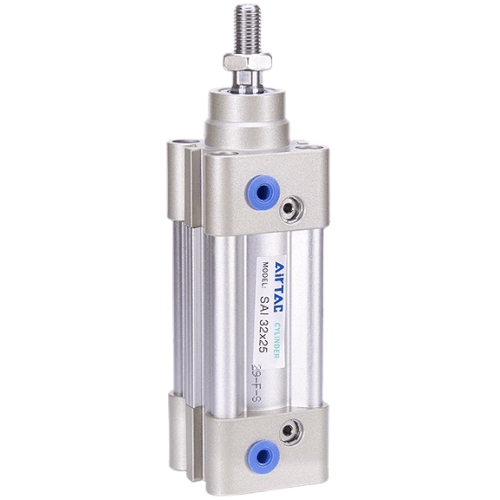
Airtac SAI125 Standard Air Cylinder SAI125X200
The AirTAC Airtac SAI125 Standard Air Cylinder SAI125X200 is a genuine double-acting ISO 15552 profile-barrel air cylinder with a Ø125mm bore and 200mm stroke, G1/2 air ports and adjustable end cushioning. Its standardized mounting interface makes it a drop-in replacement for other ISO 15552 cylinders in automation lines.
- BoreØ125 mm
- Stroke200 mm
- Port sizeG1/2
- Acting typeDouble acting
- Rod threadM27×2
- CushionAdjustable, 40 mm
About the Airtac SAI125 Standard Air Cylinder SAI125X200
The AirTAC SAI125X200 is a double-acting profile cylinder built to the ISO 15552 standard, delivering a substantial 6136 N push force at 0.5 MPa and 8590 N at 0.7 MPa. This 125 mm bore and 200 mm stroke configuration is engineered for heavy-duty machinery requiring massive thrust and a standardized mounting interface.
Unlike lighter variants, this model features a robust carbon steel piston rod and utilizes a PT tapered port thread for a secure, leak-free pneumatic connection. Because it lacks a built-in magnet, it is optimized for pure high-force actuation rather than position sensing.
Airtac SAI125 Standard Air Cylinder SAI125X200 Technical Specifications
| Model | Airtac SAI125 Standard Air Cylinder SAI125X200 |
|---|---|
| Series | SAI ISO 15552 profile cylinder |
| Bore size | Ø125 mm |
| Stroke | 200 mm |
| Acting type | Double acting |
| Port size | G1/2 |
| Rod thread | M27×2 |
| Fluid | Air (filtered by 40µm element) |
|---|---|
| Operating pressure | 0.15 – 1.0 MPa |
| Proof pressure | 1.5 MPa |
| Temperature | -20 to +70 °C |
| Speed range | 30 – 500 mm/s |
| Cushion | Adjustable, 40 mm |
| Max stroke | Up to 1500 mm |
Specifications follow the official AirTAC SAI series datasheet and ISO 15552 dimensions. Confirm against the product label before installation. Port options: G (BSPP) / NPT.
Theoretical Output Force (Ø125mm)
| Pressure | Push force | Pull force |
|---|---|---|
| 0.5 MPa | 6136 N | 5734 N |
| 0.7 MPa | 8590 N | — |
| Max (@1.0 MPa) | 1251 kgf | |
Actual usable force is lower than theoretical due to friction and back-pressure. Size with a safety margin.
Model Code: Airtac SAI125 Standard Air Cylinder SAI125X200
| SAI | ISO 15552 profile-barrel cylinder series. |
|---|---|
| 125 | Bore size in mm. |
| ×200 | Stroke length in mm. |
| -S | Optional built-in magnet for sensor position sensing. |
Related SAI-family variants: SAID (double rod), SAIJ (adjustable stroke), SAIL (with lock), SAIF (with valve), BSAI (enclasp / clamp-lock), and SAI-S with built-in magnet. Rod material: carbon steel (blank) / SUS420J2 (A) / SUS304 (B); seals: TPU (blank) / Viton H / NBR N.
Where the Airtac SAI125 Standard Air Cylinder SAI125X200 Is Used
Heavy Stamping Presses
Provides the high clamping force needed to hold heavy metal workpieces securely in place during aggressive stamping and forming operations.
Automotive Assembly Jigs
Drives large-scale robotic welding fixtures and heavy component positioning arms where a 6136 N thrust at 0.5 MPa is mandatory.
Bulk Material Diverter
Actuates heavy-duty diverter gates on high-capacity mining or aggregate conveyors, easily moving substantial loads of bulk material.
Is the Airtac SAI125 Standard Air Cylinder SAI125X200 the Right Cylinder?
Select this 125 mm bore when an 80 mm cylinder (providing 2513 N push at 0.5 MPa) is insufficient for your load requirements, but you want to avoid stepping up to the 160 mm class. The 200 mm stroke is well below the 1500 mm maximum standard stroke, keeping the assembly compact while offering high thrust.
For applications that must maintain a position or hold a load vertically when air pressure is removed or exhausted, the standard SAI cylinder will drift and drop. In those scenarios, you must specify the SAIL variant with an air-released lock or utilize an external pilot-operated check valve. To replace an existing unit, match the 125 mm bore, 200 mm stroke, PT G1/2 port, and appropriate ISO 15552 mounting accessories like FA or TC.
Quick checklist
- ✓ Required force at your working pressure
- ✓ Stroke and mounting space
- ✓ Port/thread type (PT/NPT/G)
- ✓ Magnet (-S) for sensors?
- ✓ Side load — consider a guided cylinder
Installation & Maintenance Notes
- check Use clean air filtered to 40µm or finer.
- check Keep within 0.15 – 1.0 MPa operating pressure.
- check Avoid side load on the piston rod.
- check Adjust end cushion screws for smooth stops.
- check Use correct mounting accessory (FA/FB/CA/CB/LB/TC).
- check Installation by qualified personnel per AirTAC docs.
Airtac SAI125 Standard Air Cylinder SAI125X200 FAQ
At a 0.5 MPa operating pressure, this 125 mm bore cylinder generates 6136 N of push force and 5734 N of pull force. If pressure is increased to 0.7 MPa, the push force reaches 8590 N.
Yes. The SAI125X200 is a genuine ISO 15552 profile cylinder, making its mounting interface dimensionally interchangeable with other ISO 15552 standard cylinders. Match the 200 mm stroke and G1/2 PT port for a seamless drop-in installation.
Authorized Export Seller
Genuine AirTAC parts produced by AirTAC factory.
1-Year Warranty
Covers non-human-caused product damage.
Fast Dispatch
Standard models usually ship in 3-4 days.
Fast Reply
Most inquiries answered within 7-8 hours.
Related AirTAC SAI Cylinders
Request a Quote for Airtac SAI125 Standard Air Cylinder SAI125X200
Send us the quantity and destination. We confirm price, stock and lead time — usually within 7-8 hours.