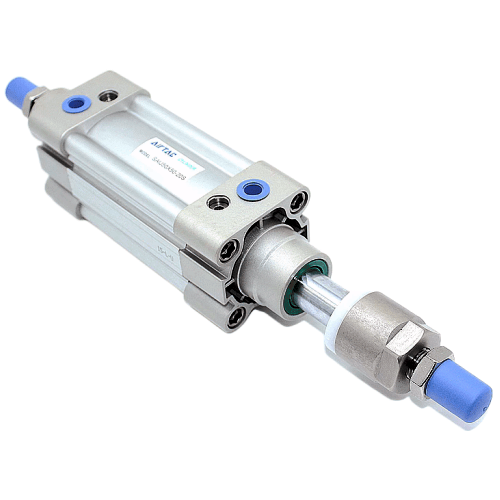
Airtac SAIJ100 Adjustable Cylinder SAIJ100X425-20
The AirTAC SAIJ100 Adjustable Cylinder SAIJ100X425-20 is a genuine double-acting ISO 15552 profile-barrel air cylinder with a Ø100mm bore and 425mm stroke, G1/2 air ports and adjustable end cushioning. Its standardized mounting interface makes it interchangeable with other ISO 15552 cylinders at the mounting interface.
- BoreØ100 mm
- Stroke425 mm
- Port sizeG1/2
- Acting typeDouble acting
- Rod threadM20×1.5
- CushionAdjustable, 36 mm
- No minimum order. A single piece can be ordered.
- Ready in 3–5 business days. That is the time we take to process the order and hand it to the carrier. Transit time after that depends on the destination.
About the Airtac SAIJ100 Adjustable Cylinder SAIJ100X425-20
The AirTAC SAIJ100X425-20 is a double-acting ISO 15552 profile cylinder equipped with a rear stroke adjuster. It provides a nominal 425 mm travel that can be fine-tuned down by 20 mm, giving operators a usable 405-425 mm end-position window during commissioning.
The extruded aluminum barrel features sensor grooves on both sides, ready to accept AirTAC CMSE reed or DMSE electronic switches if a magnet is specified later. It supports a reduced mounting set of Basic, FA, LB, TC, FTC, TCM1, and TCM2, omitting FB, CA, CB, and CR options. The rear adjuster acts purely as a mechanical stop to dial in the retract distance, meaning it cannot hold the load without live air pressure.
Airtac SAIJ100 Adjustable Cylinder SAIJ100X425-20 Technical Specifications
| Model | Airtac SAIJ100 Adjustable Cylinder SAIJ100X425-20 |
|---|---|
| Series | SAI ISO 15552 profile cylinder |
| Bore size | Ø100 mm |
| Stroke | 425 mm |
| Acting type | Double acting |
| Port size | G1/2 |
| Rod thread | M20×1.5 |
| Fluid | Air (filtered by 40µm element) |
|---|---|
| Operating pressure | 0.15 – 1.0 MPa |
| Proof pressure | 1.5 MPa |
| Temperature | -20 to +70 °C |
| Speed range | 30 – 800 mm/s |
| Cushion | Adjustable, 36 mm |
| Max stroke | Up to 1500 mm |
Specifications follow the official AirTAC SAI series datasheet and ISO 15552 dimensions. Confirm against the product label before installation. Port options: G (BSPP) / NPT.
Theoretical Output Force (Ø100mm)
| Pressure | Push force | Pull force |
|---|---|---|
| 0.5 MPa | 3682 N | 3682 N |
| 0.7 MPa | 5154 N | — |
| Max (@1.0 MPa) | 751 kgf | |
Double-rod model: the rod passes through the rear cover, so both piston faces lose rod area and push is shown at the annular-area value. Actual usable force is lower than theoretical due to friction and back-pressure. Size with a safety margin.
Model Code: Airtac SAIJ100 Adjustable Cylinder SAIJ100X425-20
| SAI | ISO 15552 profile-barrel cylinder series. |
|---|---|
| 100 | Bore size in mm. |
| ×425 | Stroke length in mm. |
| -S | Optional built-in magnet for sensor position sensing. |
Related SAI-family variants: SAID (double rod), SAIJ (adjustable stroke), SAIL (with lock), SAIF (with valve), BSAI (enclasp / clamp-lock), and SAI-S with built-in magnet. Rod material: carbon steel (blank) / SUS420J2 (A) / SUS304 (B); seals: TPU (blank) / Viton H / NBR N.
Where the Airtac SAIJ100 Adjustable Cylinder SAIJ100X425-20 Is Used
Product Changeovers
Dial in the 405-425 mm retract window during format changes on the production line without physically swapping out the actuator.
Machine Setup
Fine-tune the end-stop position during initial commissioning to perfectly align heavy 3927 N tooling loads.
Variable End Stops
Provide a mechanical retract stop for automated machinery that requires slight positional adjustments between batches.
Is the Airtac SAIJ100 Adjustable Cylinder SAIJ100X425-20 the Right Cylinder?
The adjustable 405-425 mm window is ideal for product changeovers on a line, letting you shift the retract stop without swapping the cylinder or adding external spacers. For load-holding without continuous air pressure, this standard SAIJ is insufficient; you must integrate an external rod lock or look at the SAIL or BSAI locking variants.
To replace an ISO 15552 cylinder, match the 100 mm bore, 425 mm stroke, 20 mm adjustment range, PT G1/2 port, and your required mounting bracket. Because the 425 mm stroke is relatively long, the 25 mm carbon steel rod and M20x1.5 thread can only carry limited side loads; an external guide mechanism is recommended to prevent rod binding.
Quick checklist
- ✓ Required force at your working pressure
- ✓ Stroke and mounting space
- ✓ Port/thread type (PT/NPT/G)
- ✓ Magnet (-S) for sensors?
- ✓ Side load — consider a guided cylinder
Installation & Maintenance Notes
- check Use clean air filtered to 40µm or finer.
- check Keep within 0.15 – 1.0 MPa operating pressure.
- check Avoid side load on the piston rod.
- check Adjust end cushion screws for smooth stops.
- check Use correct mounting accessory (FA/FB/CA/CB/LB/TC).
- check Installation by qualified personnel per AirTAC docs.
Airtac SAIJ100 Adjustable Cylinder SAIJ100X425-20 FAQ
At 0.7 MPa, the push force increases to 5497 N.
The rear adjuster screw acts as a mechanical stop, allowing you to shorten the effective travel from the 425 mm nominal stroke down to 405 mm. It sets the end position but does not lock the load without live air pressure.
Authorized Export Seller
Genuine AirTAC parts produced by AirTAC factory.
1-Year Warranty
Covers non-human-caused product damage.
Fast Dispatch
Standard models are processed and dispatched in 3-5 business days.
Fast Reply
Most inquiries answered within 7-8 hours.
Related AirTAC SAI Cylinders
Request a Quote for Airtac SAIJ100 Adjustable Cylinder SAIJ100X425-20
Send us the quantity and destination. We confirm price, stock and lead time — usually within 7-8 hours.