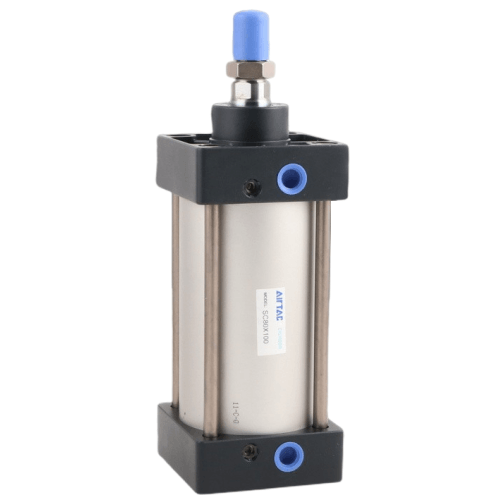
Airtac SC80 Standard Cylinder SC80X127S
The AirTAC Airtac SC80 Standard Cylinder SC80X127S is a genuine double-acting standard air cylinder with a Ø80mm bore and 127mm stroke, PT3/8 air ports and adjustable end cushioning. It is used for push, pull, lift and clamp motion in industrial automation.
- BoreØ80 mm
- Stroke127 mm
- Port sizePT3/8
- Acting typeDouble acting
- Rod threadM20×1.5
- CushionAdjustable, 28 mm
About the Airtac SC80 Standard Cylinder SC80X127S
The SC80X127S is an 80 mm bore double-acting tie-rod cylinder with a 127 mm stroke, factory-equipped with a built-in magnet (suffix -S) for direct mounting of CMSG/DMSG/EMSG reed or solid-state sensors. At 0.5 MPa it generates 2513 N pushing force and 2268 N pulling force, placing it in a mid-range force class suitable for clamping, pressing, and material-transfer tasks.
This model uses a 25 mm diameter piston rod with M20x1.5 male threads and PT3/8 ports. The 28 mm adjustable air cushion at each end decelerates the piston smoothly, and the body length A is 182 mm. The standard TPU seals give an operating temperature range of -20 to +70 °C, while the built-in magnet makes stroke-end sensing straightforward without external brackets.
Airtac SC80 Standard Cylinder SC80X127S Technical Specifications
| Model | Airtac SC80 Standard Cylinder SC80X127S |
|---|---|
| Series | SC standard tie-rod cylinder |
| Bore size | Ø80 mm |
| Stroke | 127 mm |
| Acting type | Double acting |
| Port size | PT3/8 |
| Rod thread | M20×1.5 |
| Fluid | Air (filtered by 40µm element) |
|---|---|
| Operating pressure | 0.15 – 1.0 MPa |
| Proof pressure | 1.5 MPa |
| Temperature | -20 to +70 °C |
| Speed range | 30 – 800 mm/s |
| Cushion | Adjustable, 28 mm |
| Max stroke | Up to 1500 mm |
Specifications follow the official AirTAC SC series datasheet. Operating pressure 0.15–1.0 MPa, proof pressure 1.5 MPa, temperature −20 to +70 °C. Confirm against the product label before installation. Thread options: PT (standard) / G.
Theoretical Output Force (Ø80mm)
| Pressure | Push force | Pull force |
|---|---|---|
| 0.5 MPa | 2513 N | 2268 N |
| 0.7 MPa | 3519 N | — |
| Max (approx.) | 513 kgf | |
Actual usable force is lower than theoretical due to friction and back-pressure. Size with a safety margin.
Model Code: Airtac SC80 Standard Cylinder SC80X127S
| SC | Standard tie-rod cylinder series. |
|---|---|
| 80 | Bore size in mm. |
| ×127 | Stroke length in mm. |
| -S | Optional built-in magnet for sensor position sensing. |
Related variants: SCD (double rod), SCJ (adjustable stroke), SCT (multi-position). Seals: TPU standard / H = Viton / N = NBR. Thread: blank = PT, G = G thread.
Where the Airtac SC80 Standard Cylinder SC80X127S Is Used
Package Diverting
The 127 mm stroke and 2500 N push force reliably shift cartons or totes off a conveyor lane. The built-in magnet lets a CMSG sensor confirm full extension before the next cycle.
Light Assembly Press
Delivers a controlled 2513 N at 0.5 MPa for inserting bushings or bearings. The 28 mm air cushion protects the tooling by softening end-of-stroke impact.
Sensor-Monitored Clamping
The -S magnet allows DMSG solid-state sensors to verify clamp position in automated welding or gluing fixtures, preventing cycle-start errors on unclamped parts.
Is the Airtac SC80 Standard Cylinder SC80X127S the Right Cylinder?
Choose the SC80 bore when your application needs roughly 2500 N of force at standard plant pressure; the next step up is the SC100 bore delivering 3927 N push at 0.5 MPa, while stepping down to SC63 gives 1559 N. For this 127 mm stroke the standard tie-rod construction is rigid, but if the load applies significant side force, add an external guide or switch to a guided cylinder.
To replace an existing cylinder, match five points: 80 mm bore, 127 mm stroke, PT3/8 port thread, the basic (no-bracket) mounting, and the built-in magnet (-S). The SC series is a tie-rod cylinder and is not dimensionally interchangeable with ISO 15552 profile cylinders.
Quick checklist
- ✓ Required force at your working pressure
- ✓ Stroke and mounting space
- ✓ Port/thread type (PT/NPT/G)
- ✓ Magnet (-S) for sensors?
- ✓ Side load — consider a guided cylinder
Installation & Maintenance Notes
- check Use clean air filtered to 40µm or finer.
- check Keep within 0.15 – 1.0 MPa operating pressure.
- check Avoid side load on the piston rod.
- check Adjust end cushion screws for smooth stops.
- check Use correct mounting accessory (FA/FB/CA/CB/LB/TC).
- check Installation by qualified personnel per AirTAC docs.
Airtac SC80 Standard Cylinder SC80X127S FAQ
At 0.5 MPa (≈5 bar) the cylinder produces 2513 N pushing and 2268 N pulling. At the maximum operating pressure of 1.0 MPa, theoretical push force reaches 5026 N. Always apply a safety factor for real loads.
Yes. The -S suffix means a magnet is built into the piston, so AirTAC CMSG (reed) or DMSG/EMSG (solid-state) sensors clamp directly onto the barrel tie-rods—no external brackets are needed.
Authorized Export Seller
Genuine AirTAC parts produced by AirTAC factory.
1-Year Warranty
Covers non-human-caused product damage.
Fast Dispatch
Standard models usually ship in 3-4 days.
Fast Reply
Most inquiries answered within 7-8 hours.
Request a Quote for Airtac SC80 Standard Cylinder SC80X127S
Send us the quantity and destination. We confirm price, stock and lead time — usually within 7-8 hours.