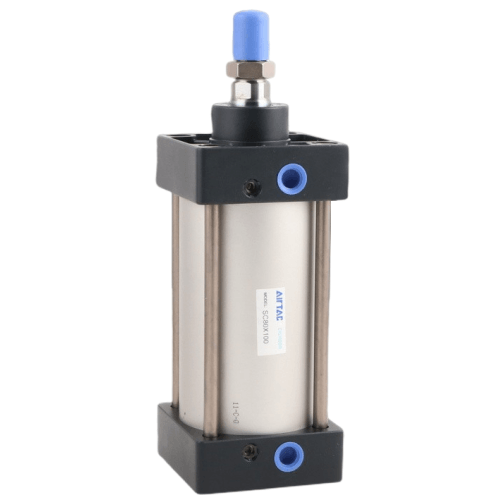
Airtac SC80 Standard Cylinder SC80X820
The AirTAC Airtac SC80 Standard Cylinder SC80X820 is a genuine double-acting standard air cylinder with a Ø80mm bore and 820mm stroke, PT3/8 air ports and adjustable end cushioning. It is used for push, pull, lift and clamp motion in industrial automation.
- BoreØ80 mm
- Stroke820 mm
- Port sizePT3/8
- Acting typeDouble acting
- Rod threadM20×1.5
- CushionAdjustable, 28 mm
About the Airtac SC80 Standard Cylinder SC80X820
The AirTAC SC80X820 is a double-acting tie-rod cylinder delivering 2513 N of push force at 0.5 MPa and up to 4523 N at 0.9 MPa, making it a robust linear drive for medium-to-long stroke applications. Its 25 mm diameter piston rod and 28 mm adjustable air cushion at each end provide reliable deceleration, while the PT3/8 ports ensure straightforward pneumatic connection.
With an 820 mm stroke and a body length A of 182 mm, this cylinder suits tasks requiring extended reach, such as material transfer or pressing operations. The standard TPU seals offer a -20 to +70 °C operating range, and the tie-rod construction simplifies maintenance. This is a genuine AirTAC SC unit, factory-tested for consistent performance.
Airtac SC80 Standard Cylinder SC80X820 Technical Specifications
| Model | Airtac SC80 Standard Cylinder SC80X820 |
|---|---|
| Series | SC standard tie-rod cylinder |
| Bore size | Ø80 mm |
| Stroke | 820 mm |
| Acting type | Double acting |
| Port size | PT3/8 |
| Rod thread | M20×1.5 |
| Fluid | Air (filtered by 40µm element) |
|---|---|
| Operating pressure | 0.15 – 1.0 MPa |
| Proof pressure | 1.5 MPa |
| Temperature | -20 to +70 °C |
| Speed range | 30 – 800 mm/s |
| Cushion | Adjustable, 28 mm |
| Max stroke | Up to 1500 mm |
Specifications follow the official AirTAC SC series datasheet. Operating pressure 0.15–1.0 MPa, proof pressure 1.5 MPa, temperature −20 to +70 °C. Confirm against the product label before installation. Thread options: PT (standard) / G.
Theoretical Output Force (Ø80mm)
| Pressure | Push force | Pull force |
|---|---|---|
| 0.5 MPa | 2513 N | 2268 N |
| 0.7 MPa | 3519 N | — |
| Max (approx.) | 513 kgf | |
Actual usable force is lower than theoretical due to friction and back-pressure. Size with a safety margin.
Model Code: Airtac SC80 Standard Cylinder SC80X820
| SC | Standard tie-rod cylinder series. |
|---|---|
| 80 | Bore size in mm. |
| ×820 | Stroke length in mm. |
| -S | Optional built-in magnet for sensor position sensing. |
Related variants: SCD (double rod), SCJ (adjustable stroke), SCT (multi-position). Seals: TPU standard / H = Viton / N = NBR. Thread: blank = PT, G = G thread.
Where the Airtac SC80 Standard Cylinder SC80X820 Is Used
Long-Reach Material Transfer
The 820 mm stroke pushes or pulls components between distant conveyor stations, providing the 2513 N force needed to move heavy totes or pallets in packaging lines.
Waste Compaction
Generates up to 4523 N at 0.9 MPa to compress recyclable materials or waste into containers, leveraging the full stroke for deep compaction chambers.
Extended Press Operations
Ideal for laminating or assembly presses where a long 820 mm stroke is needed to load and unload large panels, with adjustable cushioning to protect tooling.
Is the Airtac SC80 Standard Cylinder SC80X820 the Right Cylinder?
Select the SC80 bore when your application needs between 2513 N and 4523 N of force; for lower force requirements around 1559 N, consider stepping down to the SC63, while for higher demands up to 3927 N at 0.5 MPa, the SC100 is the next step up. Always match the bore, 820 mm stroke, PT3/8 port thread, and basic mounting when replacing an existing cylinder.
At 820 mm stroke, the unsupported rod is susceptible to bending under side loads. For this extended length, it is critical to use an external linear guide or ensure the load is purely axial to prevent rod bearing damage and premature seal wear. If side loads are unavoidable, consider a guided cylinder instead.
Quick checklist
- ✓ Required force at your working pressure
- ✓ Stroke and mounting space
- ✓ Port/thread type (PT/NPT/G)
- ✓ Magnet (-S) for sensors?
- ✓ Side load — consider a guided cylinder
Installation & Maintenance Notes
- check Use clean air filtered to 40µm or finer.
- check Keep within 0.15 – 1.0 MPa operating pressure.
- check Avoid side load on the piston rod.
- check Adjust end cushion screws for smooth stops.
- check Use correct mounting accessory (FA/FB/CA/CB/LB/TC).
- check Installation by qualified personnel per AirTAC docs.
Airtac SC80 Standard Cylinder SC80X820 FAQ
At 0.5 MPa, the push force is 2513 N and the pull force is 2268 N. At the maximum operating pressure of 0.9 MPa, the push force increases to 4523 N. The theoretical maximum force at 1.0 MPa is 513 kgf.
No. An 820 mm stroke with a 25 mm rod creates a long lever arm that magnifies side loads, risking rod bending and seal failure. You must use an external guide rail or a rod-alignment coupler to absorb any non-axial forces.
Authorized Export Seller
Genuine AirTAC parts produced by AirTAC factory.
1-Year Warranty
Covers non-human-caused product damage.
Fast Dispatch
Standard models usually ship in 3-4 days.
Fast Reply
Most inquiries answered within 7-8 hours.
Request a Quote for Airtac SC80 Standard Cylinder SC80X820
Send us the quantity and destination. We confirm price, stock and lead time — usually within 7-8 hours.