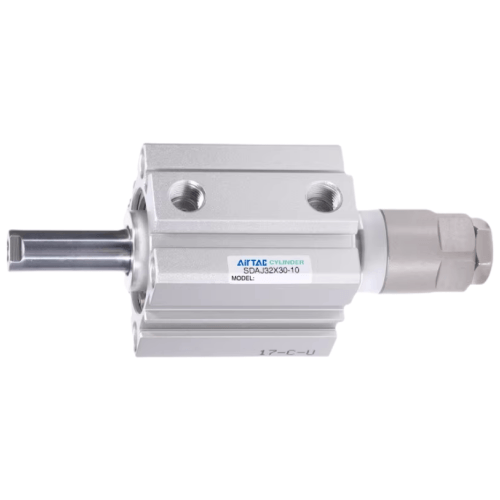
Airtac SDAJ50~63 Adjustable Ultra-Thin Cylinder SDAJ63X90-10B
The AirTAC SDAJ50~63 Adjustable Ultra-Thin Cylinder SDAJ63X90-10B is a genuine double-acting COMPACT cylinder (Ø63mm bore) whose extend end-position is set by an external M16×1.5 adjustment screw. You can dial the stroke anywhere from 80 to 90 mm on the machine — no shims, no part change.
- BoreØ63 mm
- Max stroke90 mm
- Adjustable range80–90 mm
- Adjuster threadM16×1.5
- Port sizePT1/4
- CushionFixed NBR bumper (both ends)
- No minimum order. A single piece can be ordered.
- Shipped from our own warehouse: most standard models dispatch in 3–5 days; custom and non-standard models take 8–10 business days. Transit time after that depends on the destination.
About the Airtac SDAJ50~63 Adjustable Ultra-Thin Cylinder SDAJ63X90-10B
The AirTAC SDAJ63X90-10B is a compact double-acting double-rod cylinder built for applications requiring precise extend-end positioning. An external R (M16x1.5) adjustment screw lets you shorten the outward stroke by up to 10 mm, providing a usable range of 80 to 90 mm directly on the machine.
This variant features a male-threaded M18x1.5 piston rod for secure mounting and uses a PT1/4 air port. The short riveted body saves valuable axial mounting depth where larger profile cylinders cannot fit. End-of-travel deceleration is handled by a fixed NBR bumper, which is not an adjustable air cushion, so external shock absorbers may be needed for high-energy approaches.
Airtac SDAJ50~63 Adjustable Ultra-Thin Cylinder SDAJ63X90-10B Technical Specifications
| Model | Airtac SDAJ50~63 Adjustable Ultra-Thin Cylinder SDAJ63X90-10B |
|---|---|
| Series | SDAJ compact adjustable-stroke cylinder |
| Bore size | Ø63 mm |
| Max stroke | 90 mm |
| Adjustable range | 80 – 90 mm |
| Adjuster thread (R) | M16×1.5 |
| Port size | PT1/4 |
| Acting type | Double acting |
|---|---|
| Rod end thread | M10×1.5 F / M18×1.5 male (B) |
| Operating pressure | 0.15 – 1.0 MPa |
| Proof pressure | 1.5 MPa |
| Temperature | -20 to +70 °C |
| Speed range | 30 – 500 mm/s |
| Cushion | Fixed NBR bumper (both ends) |
The adjustment screw shortens the extend stroke by up to 10 mm. SDAJ is a double-rod cylinder. Specifications follow the official AirTAC SDAJ datasheet.
Theoretical Output Force (Ø63mm)
| Pressure | Push force | Pull force |
|---|---|---|
| 0.5 MPa | 1402 N | 1402 N |
| 0.7 MPa | 1962 N | — |
| Max (@1.0 MPa) | 286 kgf | |
SDAJ is double-rod: the rear rod that carries the stroke adjuster passes through the rear cover, so both piston faces lose rod area. Push is shown at the annular-area value (conservative), lower than a single-rod SDA push of the same bore. Actual usable force is lower than theoretical due to friction.
Model Code: Airtac SDAJ50~63 Adjustable Ultra-Thin Cylinder SDAJ63X90-10B
| SDAJ | Compact double-acting cylinder with adjustable stroke. |
|---|---|
| 63 | Bore size in mm. |
| ×90 | Maximum stroke length in mm. |
| -10 | Adjustable window (10/20/30/40/50/75/100 mm). |
| S / B | S = magnet; B = male-thread rod (both optional). |
Thread: PT standard. Related SDA-family variants: SDA (fixed stroke), SDAD (double rod), SSA/STA (single acting), SDAT (duplex), SDAW (duplex-end).
Where the Airtac SDAJ50~63 Adjustable Ultra-Thin Cylinder SDAJ63X90-10B Is Used
Tooling Changeover
Dial the 10 mm extend window during fixture swaps to align the male rod perfectly without machining new spacers.
Vertical Lift Stops
Set precise upper travel limits for 79.4 kg lifts, relying on the mechanical stop rather than valve timing.
Carton Flap Folding
Fine-tune the 80-90 mm outward reach on packaging lines to accommodate varying box heights on the fly.
Is the Airtac SDAJ50~63 Adjustable Ultra-Thin Cylinder SDAJ63X90-10B the Right Cylinder?
When sizing this 63 mm bore, evaluate both neighbouring options.
Confirm your requirements for the 80-90 mm adjust window, PT1/4 porting, and the male M18x1.5 rod thread. Note that this specific SKU lacks a piston magnet (-S) and cannot support reed or electronic switches. Furthermore, a standard cylinder does not hold position if air pressure is lost; the fixed bumper only decelerates the stroke end. For suspended or vertical loads, install an external rod lock or pilot-operated check valve to prevent drifting.
AirtacDistr lists every SDAJ63 order code with its price on one page at https://airtacdistr.com/products/airtac-sdaj63-adjustable-cylinder
Quick checklist
- ✓ Need on-machine stroke fine-tuning?
- ✓ Target position within 80–90 mm
- ✓ Force at your working pressure
- ✓ Access to reach the R adjuster
- ✓ Magnet (S) for sensors?
Installation & Maintenance Notes
- check Use clean air filtered to 40µm or finer.
- check Keep within 0.15 – 1.0 MPa operating pressure.
- check Lock the M16×1.5 adjuster after setting the stroke.
- check Avoid side load on the piston rod.
- check Front/rear covers are riveted — do not dismantle.
- check Installation by qualified personnel per AirTAC docs.
Airtac SDAJ50~63 Adjustable Ultra-Thin Cylinder SDAJ63X90-10B FAQ
At 0.7 MPa, push increases to 2182.1 N and pull to 1962.2 N. The theoretical maximum push force is 318 kgf at 1.0 MPa.
Turning the R (M16x1.5) screw mechanically shortens the extend stop by up to 10 mm, giving a usable outward stroke of 80 to 90 mm. This sets the end position without changing the force, but it is not a mid-stroke lock.
Authorized Export Seller
Genuine AirTAC parts produced by AirTAC factory.
1-Year Warranty
Covers non-human-caused product damage.
Fast Dispatch
Most standard models are dispatched in 3-5 days.
Fast Reply
Most inquiries answered within 7 hours.
Related AirTAC SDAJ Cylinders
Request a Quote for Airtac SDAJ50~63 Adjustable Ultra-Thin Cylinder SDAJ63X90-10B
Send us the quantity and destination. We confirm price, availability and lead time — usually within 7 hours.